


Connect.
Upload files or connect recurring exports from the systems each company already uses.
Turn inconsistent company data into one approved dataset.
The operational data problem
Business data lives across spreadsheets, SaaS exports, databases, and one-off reports. Field names change, schemas drift, and every workflow depends on someone knowing which version is right. Convergent turns that mess into a governed data layer with approved schemas, monitored pipelines, and stable outputs.
One contract across companies
Each company can keep sending the files and exports it already has. Convergent maps those layouts into an approved contract, so downstream consumers integrate once instead of rebuilding around every source.
Company A
Order Date · Item · Net Sales
Company B
Day · Product · Revenue
Company C
date · sku_name · total_net
Approved contract
operating_sales
Product
Schema mapping, pipeline generation, drift detection, and governed serving in one product.
Schema engine
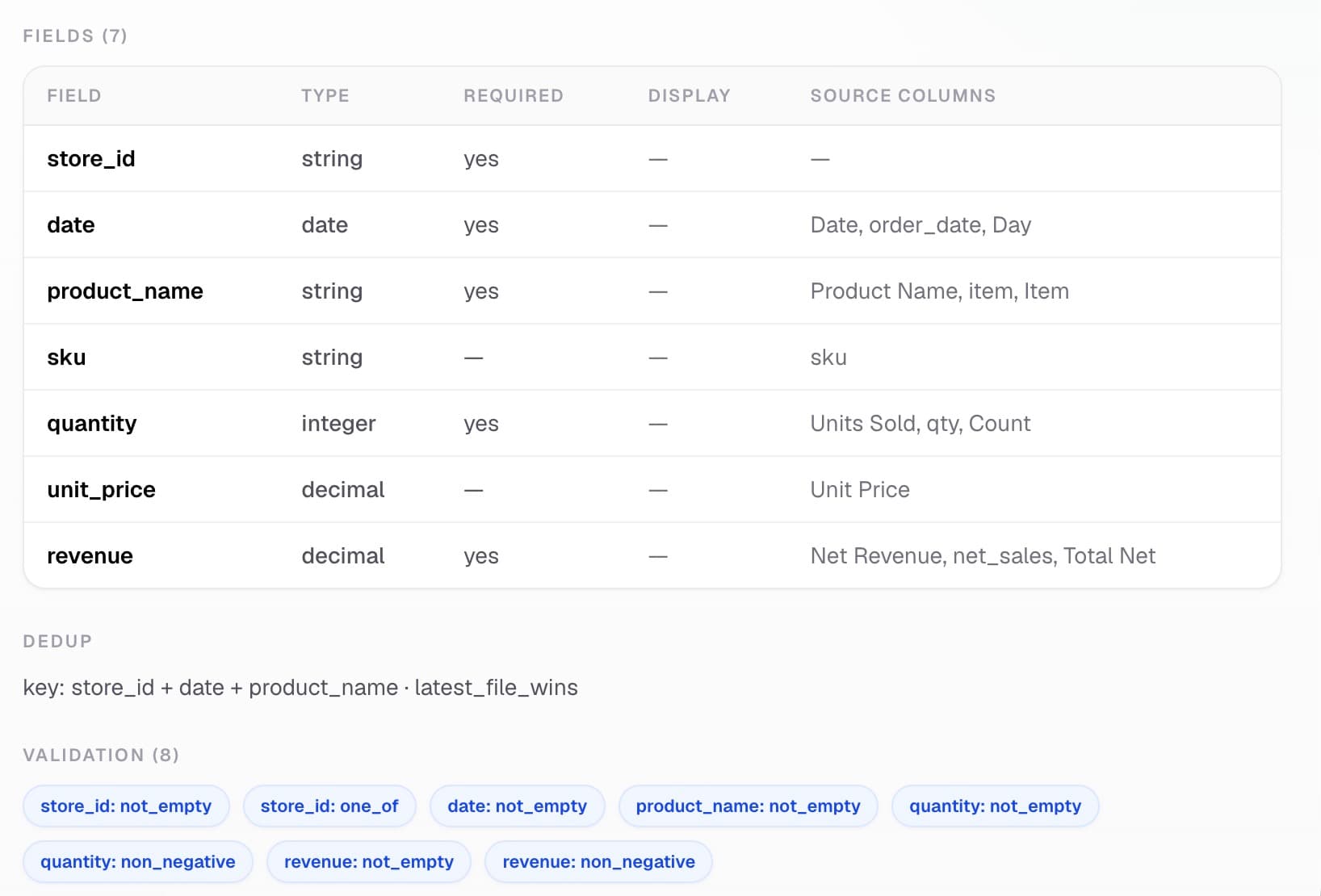
Convergent proposes canonical fields across inconsistent source data, shows confidence levels, and routes ambiguous mappings for human review.
Pipeline generation
Once a schema is approved, Convergent runs normalization pipelines, validates incoming data, and monitors drift as sources change.
Governed delivery
Give applications paginated REST records, hand analysts full CSV or JSON exports, and let agents connect through MCP. Every format follows the same approved field order and schema version.
Approved dataset
Weekly sales
REST
Paginated records
CSV
Full export
JSON
Full export
MCP
Agent access
GET
/api/v1/datasets/weekly-sales/records?limit=100
{
"spec_version": 3,
"snapshot": "3:1482:...",
"records": [{ ... }]
}
Platform capabilities
How it works
Upload files or connect recurring exports from the systems each company already uses.
Convergent proposes a canonical schema and highlights fields that need approval.
Review representative source layouts, validation rules, and the update behavior before data is served.
Deliver the approved dataset through REST, CSV, JSON, or MCP without changing the contract for consumers.
Predictable updates
Convergent keeps update behavior explicit while parse checks, layout-aware previews, and quarantine keep unexpected data away from approved outputs.
New values replace rows with the same approved grain key.
Existing rows stay untouched while unseen keys are added.
The source is upserted, then records missing from that source are removed.
Use cases
Use Convergent when important workflows depend on exports, reports, and systems that were never designed to work together.
Normalize store reports, vendor invoices, labor exports, and regional files into one reporting layer.
Unify POS exports, warehouse data, supplier feeds, and merchandising reports across systems.
Prepare GL extracts, budget files, and entity-level reports for models, dashboards, and agents.
Give agents governed access to business data without exposing raw systems or brittle scripts.
Security
Convergent keeps organizations separated, connects to supported sources with read-only access, and serves approved datasets through revocable, dataset-scoped API keys.
Create revocable live keys and restrict a key to one approved dataset when a consumer should not see anything else.
Each organization's data and schema definitions are fully isolated. Nothing crosses tenant boundaries.
Draft specifications stay private. Only datasets with an approved contract are available through serving endpoints.
Only an approved dataset is available through REST, CSV, JSON, or MCP.
FAQ
Have a recurring export or cross-company reporting problem? Bring us a representative dataset and we'll scope a focused pilot.
ETL tools move data. Convergent creates and maintains the governed contract around that data: canonical schemas, approval workflows, drift detection, and stable interfaces for agents and internal systems.
Your team does. Convergent proposes mappings and flags uncertainty, but ambiguous fields and schema changes can require human approval before they affect downstream consumers.
Convergent validates incoming files against the approved contract. Malformed files stay out of the pipeline, distinct layouts are sampled before approval, and invalid rows can be inspected without silently changing the served dataset.
Convergent uses organization-level tenant isolation, read-only source connections, approval gates, and revocable API keys that can be scoped to one dataset.